
I had never met a psychiatrist before, so I had no idea what to expect. But when the secretary told me over the phone that I was lucky to get an appointment with the pill wizard, I started believing in miracles. At least at first. Anxiety pushes you to grab onto anything within reach, because it conditions the brain to find a solution, fast. This wizard was my branch of the moment, and I couldn’t wait to meet him.
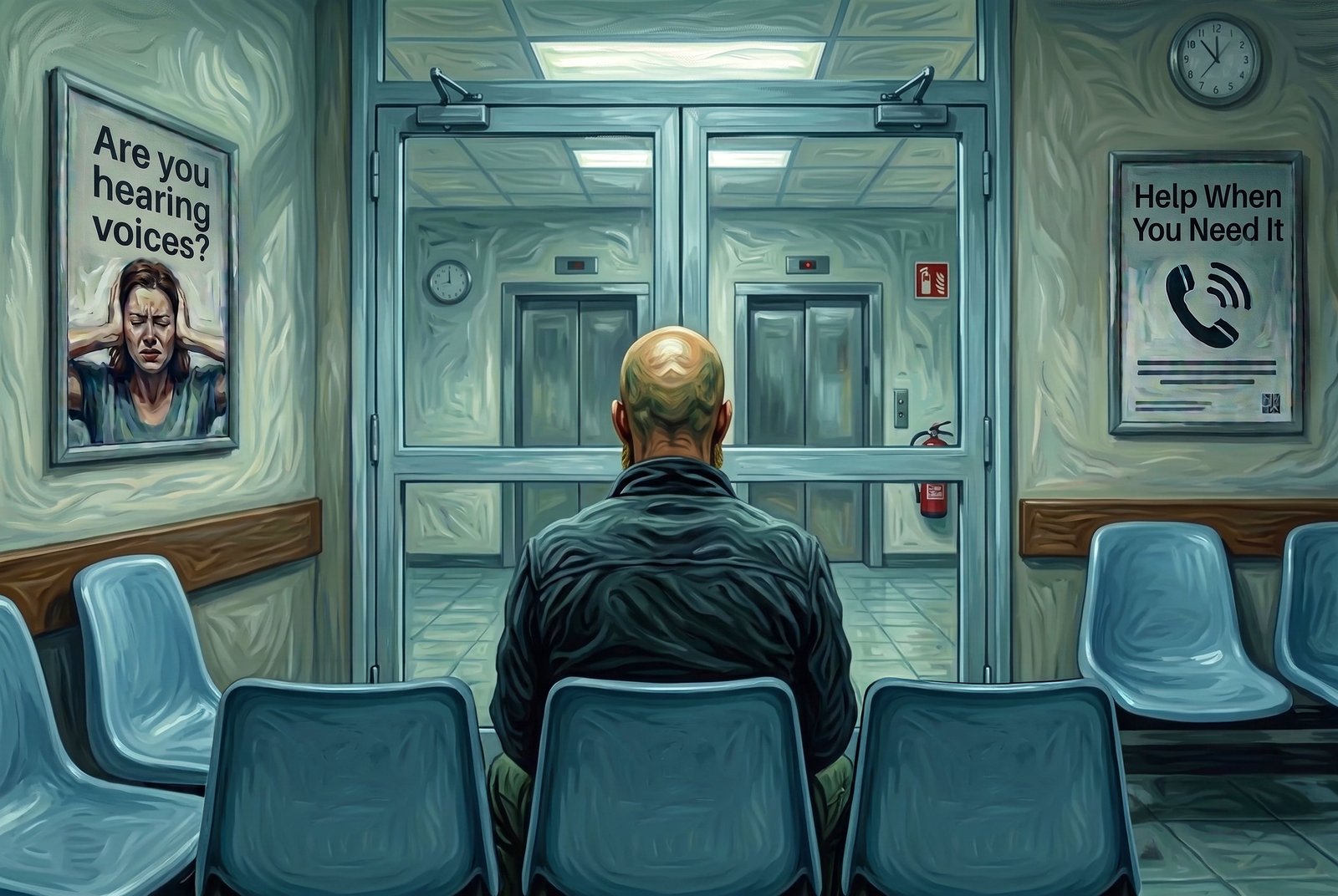
The day of the appointment, I found myself in the waiting room of a community health center, a publicly funded care facility. Sitting in a medical waiting room chair, I stared at the posters on the walls around me.
Hearing voices? Call us at …
Suicide helpline. Anonymous and free.
I was alone in the waiting room, sitting on a plastic chair, facing the entrance, with the elevators in the background.
To my left, a long hallway with identical doors that, in all likelihood, opened onto equally identical consultation rooms.
I waited.
I watched the elevator doors open regularly. A few staff members came and went. Sometimes patients. Everyone looked at the end of their rope, some appeared to be in crisis, in withdrawal, or completely out of it. Great atmosphere.
I was among the crazies. Sitting in my chair, I realized I had become a mental patient. I told myself there was still a lot of work to be done, that a psychiatrist’s waiting room shouldn’t be anxiety-inducing or depressing. Everything was designed to make me uncomfortable: the carpet color, the posters on the walls, the plastic plants, the long hallway, and the staff who seemed just as depressed as the patients.
Finally, a door opened and the wizard called my name.
He was a normal man, fifties, fairly pleasant, slight smile, direct and open gaze.
I told him my story, my medication history. He quickly put a label on me: generalized anxiety disorder. Then he prescribed a new antidepressant and an antipsychotic. The fact that I was on benzodiazepines didn’t bother him. He renewed the prescription.
I didn’t feel rushed. He took his time, asked questions, and I had the sense he genuinely wanted to help. But all his solutions involved swallowing various pills. He suggested we try everything and meet again in three weeks to review and adjust.
He also gave me his email address, which I found reassuring and rare enough to be worth mentioning. He surely regretted it later, given the number of messages he received from me during crises.
I left feeling mentally neutral. Neither optimistic nor pessimistic. Neither terrified nor light. Just relieved. Leaving my apartment had become an ordeal. Sitting in waiting rooms was another. I had nothing to lose by trying other medications, but I wasn’t expecting immediate relief.
Obviously, the new medications resolved nothing. The antipsychotics knocked me out. I slept better but struggled to wake up in the morning and stayed comatose for part of the day. I felt the activation side effects of the new antidepressant for a few days, but nothing serious. I saw no notable change in my mental state.
I spent the following months meeting with him every three weeks or so. We tried several medications, including pregabalin, an anticonvulsant supposed to have an anxiolytic effect without the dependency issues of benzodiazepines. I took my first dose on a Sunday morning and very quickly found myself in a state of panic, curled up on my couch. I sent him an email, and he replied telling me to stop taking it without even trying to convince me that my state wasn’t related to the medication, but to my perception. Every side effect from a new medication, even a minor one, was always dissected and analyzed, and my hypervigilance only made things worse. I was my own worst enemy.
Over time, I lost hope. I was trying everything, but nothing seemed to have any real effect, and getting to my appointments had become an ordeal in itself. I couldn’t take public transit, so I went on foot, and the 30-minute walk was agony. Seeing other people happy and carefree had become unbearable. Why were they so effortlessly happy? What was wrong with me?
My psychiatrist wasn’t a pill wizard. Or maybe my case was too severe, I was beyond saving, and even his superpowers weren’t enough. If he had failed, no one could succeed.
At an appointment a few days later, seeing my discouraged face, he looked at me with full confidence and said: finally, we know what works for you, it’s Ativan. That’s your molecule.
I looked at him, deflated. After all those trials, all those capsules, tablets, and pills swallowed, my pill wizard was telling me without shame that I could only be helped by one of the most addictive classes of medication.
I left discouraged, determined never to see him again, but went back a few weeks later anyway because I had no other choice. He was my only lifeline, the only person who seemed interested in my case, the only one who listened. My search for a therapist was going nowhere, the waitlists during this COVID era were full. He wasn’t perfect, he wasn’t a wizard, but he was all I had.
Over the following months, my condition slowly began to improve. He had nothing to do with it. I owed this progress to a handful of small things I had put in place in my life that were starting to pay off: seeing people, going out, acting, living, traveling, despite everything.
My appointments with my psychiatrist naturally spaced out. Our meetings were no longer crisis management sessions. They started looking more and more like informal conversations between friends.
He showed increasing interest in my love life, my libido, and asked a lot of questions about my day-to-day functioning. I then realized that the commute and the ordeal of the waiting room weren’t worth it anymore. I had other lifelines available. I didn’t need him the way I used to. I decided it was time to end our collaboration.
At our final appointment, the pill wizard told me that exercise would be a good idea, since it helps reduce anxiety. Six months of follow-up for that…
Leave a Reply